Memorandum submitted by Harvesthelp, Farm
Africa and Send a Cow
GOVERNMENTS' AND DFID'S SUPPORT TO AGRICULTURE
IN AFRICA
REVIEW OF PROGRESS MADE TOWARDS FULFILLING
THE COMMITMENTS
EXECUTIVE SUMMARY
1. Agriculture remains key to poverty reduction
and achieving the poverty targets of the Millennium Development
Goals (MDGs) in Africa. More than 75% of the populations in sub-Saharan
African countries live in rural areas and directly depend on agriculture
for their livelihoods. African countries, agreed through the New
Partnership for Africa's Development (NEPAD), the continental
development plan, to prioritize agriculture as extremely important
for the continents development and poverty reduction. To realise
this, several African governments committed themselves to allocating
at least 10% of their national budgets to agriculture within five
years. This was agreed at the African Union meeting held in Maputo
in 2003.
2. The African government's also agreed
on the need for Africa's external partners to allocate more of
their assistance to the CAADP's four priorities. DFID being one
of the largest bilateral donor to most sub-Sahara African countries
recognises the important role of agriculture in growth and poverty
reduction for the continent in its policy paper of 2005: Growth
and poverty reduction: the role of agriculture and committed
itself to support the sector.
3. This paper presents findings from the
review of commitments and progress made by sub-sahara African
government's and donors, particularly the Department for International
Development (DFID) in supporting agriculture to achieve economic
growth and poverty reduction in Africa. The review focused on
seven countries namely Ethiopia, Kenya, Malawi, Rwanda, Tanzania,
Uganda and Zambia. This review was jointly undertaken by Harvest
help, Farm Africa, and Send A Cow, which are all UK based Charities
supporting sustainable livelihoods in Africa.
The following were the conclusions made from
the review:
(a) Despite agriculture being prioritised
by most African countries as an engine for economic growth and
poverty reduction in their various national pro-poor policies
and strategies, it does not receive the levels of funding commensurate
to its level of priority. There has not been a significant movement
towards achieving the 10% target over the past three years as
most countries have maintained fairly similar percentages (between
3 to 5%) since the Maputo Declaration in 2003.
(b) Expenditures of most Ministries of Agriculture
are directed towards financing administrative costs (staff salaries
and emoluments), institutional support and subsidies at the expense
of agriculture activities such as research, extension and marketing,
which have high investment returns and are more sustainable.
(c) DFID funding for agriculture and rural
livelihoods is mainly channeled through Poverty Reduction Budget
Support (PRBS), which allows governments in line with their national
plans to determine how to best tackle poverty. This is with exception
of Ethiopia, which had its PRBS suspended in 2005.
(d) Overall DFID's support to agriculture
and livelihoods in Africa has been steadily declining over the
last five years. Furthermore, the level of financial support to
the sector has been very low compared to other sectors such as
education and health. This clearly shows that DFID has not been
fully committed to supporting agriculture, which it recognised
in its policy paper (2005) as key in economic growth and poverty
reduction in Africa.
(e) Although DFID recognises agriculture
as important for growth and poverty reduction in Africa, it is
not highly emphasised in the its Country Assistance Plans (CAPs)
for most countries as compared to education, health, governance
and public sector management.
4. Based on the conclusions above, FARM-Africa,
send a Cow and Harvest Help call on the UK Government, through
DFID, to consider the following actions:
(a) DFID should ensure that bi-lateral agreements
with the countries under consideration compels their government's
to commit at least 10% of national budget to agriculture in accordance
with the Maputo Declaration of 2003.
(b) DFID and other cooperating partners should
ensure that future investment in agriculture in these countries
is directed towards areas with high returns and greater sustainability
than the current form of investment.
(c) Based on the lessons from Tanzania, DFID
could continue supporting Agriculture through PRBS but should
go a step further to clearly define or earmark support to agriculture
as in the case of the education and health sectors.
(d) In order to accelerate economic growth
and poverty reduction in Africa, DFID should increase its support
to agriculture and rural livelihoods from the current level of
less than 2% to at least 10% of total aid.
(e) DFID should highly emphasise the agriculture
sector in its CAP as a key sector in economic growth and poverty
reduction in Africa in line with its policy paper of 2005: Growth
and poverty reduction: the role of agriculture.
INTRODUCTION
5. Agriculture remains key to poverty reduction
and achieving the poverty targets of the Millennium Development
Goals (MDGs) in Africa. More than 75% of the populations in sub-Saharan
African countries live in rural areas and directly depend on agriculture
for their livelihoods. Agriculture also contributes a significant
share to the countries GNI in form of tax and foreign exchange.
Therefore, agriculture is an important economic engine for most
African economies.
6. Many problems facing Africa today are
due to decreasing investment by donor and African governments
in agriculture over the last 20 years[3].
According to "id21 insights" the Organisation for Economic
Co-operation and Development estimates that global financial assistance
for African agriculture decreased from US$6.2 billion to US$2.3
billion between 1980 and 2002, with funding going to other sectors
instead. The main reason for this downward trend in the support
to agriculture was mainly because donors and governments felt
that agriculture had failed to achieve sufficient progress towards
food security.
7. However, most African governments including
donor agencies recognize agriculture as an important engine to
poverty reduction and the achievement of MDGs on poverty. This
paper therefore, reviews various commitments and progress made
by sub-sahara African government's and donors, particularly the
Department for International Development (DFID) in supporting
agriculture to achieve economic growth and poverty reduction in
Africa. The focus of this review is mainly on governments' and
DFID's spending on agriculture in seven African countries namely
Ethiopia, Kenya, Malawi, Rwanda, Tanzania, Uganda and Zambia.
This review would be used to provide input into a briefing paper
that will be used by an MP to ask a question in the house about
DFID's success in implementing its agricultural strategy.
GOVERNMENT'S
COMMITMENTS TO
AGRICULTURE
8. Most sub-sahara African countries, agreed
through the New Partnership for Africa's Development (NEPAD),
the continental development plan, to prioritize agriculture as
extremely important for the continents development and poverty
reduction. This was based on the premise that Africa is largely
a rural continent and that the agriculture sector accounts for
about 60% of the total labour force, 20% of total merchandise
exports and 17% of GDP. The Comprehensive Africa Agriculture Development
Programme (CAADP) under NEPAD aims to address Africa's agricultural
needs through the following four pillars of development:
— Extending the area under sustainable
land management and reliable water control systems, for example
by increasing access to irrigation.
— Increasing market access through
improved rural infrastructure and other trade-related interventions.
— Increasing food supply and reducing
hunger across the region by increasing smallholder farm productivity
and improving responses to food emergency crises.
— Improving agricultural research and
systems of dissemination.
9. To realise this, several African governments
committed themselves to allocating at least 10% of their national
budgets to agriculture within five years. This was agreed at the
African Union meeting in Maputo in 2003. Furthermore, various
government's have developed broad national polices and strategies
for poverty reduction in which they have prioritized agriculture.
10. The African government's also agreed
on the need for Africa's external partners to allocate more of
their assistance to the CAADP's four priorities. DFID being one
of the largest bilateral donor to most sub-Sahara African countries
recognises the important role of agriculture in growth and poverty
reduction for the continent.
DFID'S COMMITMENTS
TO AGRICULTURE
11. DFID, in its policy paper of 2005: Growth
and poverty reduction: the role of agriculture, emphasises
that Agriculture is a key part of its contribution to reduce global
poverty and achieve MDGs. The policy also highlights DFID's commitment
to improving agriculture performance particularly in Africa through
the following actions:
(a) Help build capacity of and accountability
of governments to direct public spending especially where it will
have greatest impact on agriculture growth and poverty reduction.
This may include spending on ministries other than agriculture.
(b) Where appropriate, encourage governments
to allocate resources to rural infrastructure—particularly
roads—and support efforts to involve the private sector
in funding infrastructure.
PROGRESS MADE
TOWARDS FULFILLING
THE COMMITMENTS
12. The matrix in Annex 1 provides a summary
review of governments' and DFID's support to the seven African
countries according to the following issues:
— the percentage of national budgets
spent on agriculture over the last five years;
— how each country allocated its agricultural
budget over the last five years;
— how many countries receive Direct
Budget Support (DBS) from the UK government;
— DFID's spending on the agricultural
sector over the last five years; and
— understanding of the prominence that
DFID gives agriculture in its Country Assistance Plans.
13. Findings indicated in the matrix (Annex
1) clearly show that most countries were far below the 10% target
of their national budgets going to agriculture in the period 2000-05.
Almost all the countries' budgets to agriculture between this
period ranged between 3 to 5% of national budgets. The data in
the matrix also shows that there has not been a significant movement
towards the 10% target over the past three years as most countries
have maintained fairly similar percentages since the Maputo Declaration.
This is with exception of Malawi and Ethiopia, which allocated
about 12.2% and 16% to agriculture in 2005-06 and 2004-05, respectively.
However, it is worthy noting that allocations in most cases are
higher than actual expenditures.
14. Furthermore, expenditures of most Ministries
of Agriculture are directed towards financing administrative costs
(staff salaries and emoluments), institutional support and subsidies
at the expense of agriculture activities such as research, extension
and marketing, which have high investment returns and are more
sustainable. For example, Zambia, had more resources (74%) financing
the Fertilizer Support Programme in the 2006 budget. According
to DFID 2004, about 75% of public spending in agriculture in Kenya
is absorbed by parastatals, to perform functions which have been
designated by the Govenment as "non-core" functions.
In addition, extension consumes most of the budget in form of
salaries amounting to US$50 million per annum to staff who have
no operating funds. However, the pattern of expenditure is different
with Tanzania, which spent more than 37 % of its total budget
in 2002-03 to finance research and extension and 9% as institutional
support.
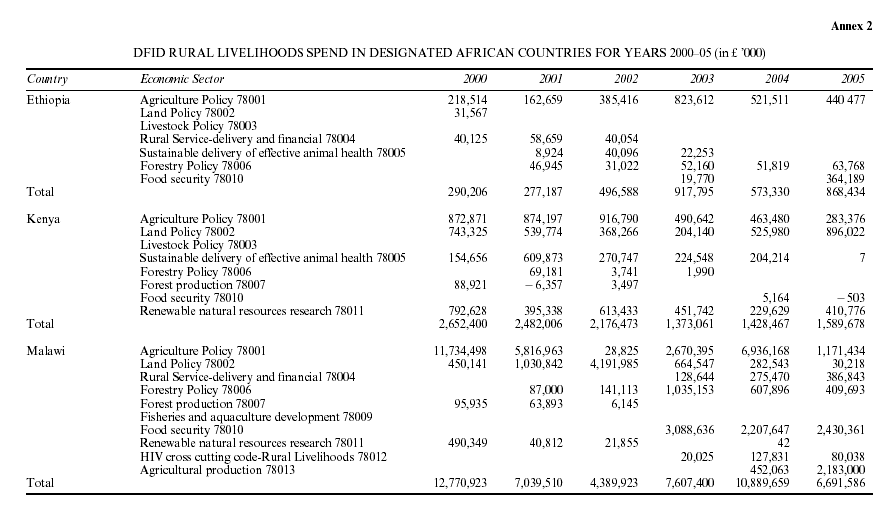
15. This review also indicates that DFID
has been committed to supporting agriculture and livelihoods to
many African countries mainly in areas of policy formulation and
implementation eg Agriculture, land and forestry policies including
natural resources development and food security (see Annex 2).
Others include support for renewable rural service-delivery and
financial management and HIV/AIDS as a cross cutting issue. This
support has been channelled mainly through Poverty Reduction Budget
Support (PRBS). However, PRBS to Ethiopia was suspended in 2005.
In some countries, PRBS represents up to 70% of DFID's bilateral
programme. In future DFID intends to increase its overall aid
and Direct Budget Support to many countries eg PRBS is projected
to double to around £1.2 billion by 2007-08 in the case of
Tanzania. However, lessons from Tanzania (DFID 2004, Official
Assistance to Agriculture) indicates the limitations of DBS which
included greater relative ease of channeling funds to other well
defined sectors, such as health and education. The other lesson
learnt was that Poverty Reduction Budget Support (PRBS) tended
to result in a shift in decision-making processes and resource
allocations that work against investments in agriculture. It was
also learnt that Ministries may not be capable of making a convincing
case with the Finance Minister for scarce budgetary resources
to Agriculture. Decisions about resource allocation are increasingly
left in the hands of ministries of finance. Ministries of agriculture
are invariably the weakest of the sectors.
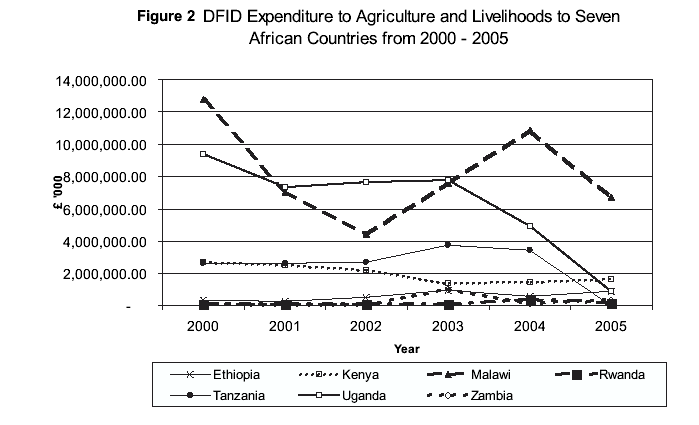
16. Figures 1 and 2 below indicate that
the proportion of DFID funding for rural livelihoods through DBS
channels is low and has been steadily declining compared to other
sectors over the period 2000-01 and 2005-06. Support to agriculture
as a percentage of total aid/expenditure to Africa declined from
4.72% in financial year 2003-04 to 1.37% in financial year 2005-06.
Even in the year 2005-06 when DIFID developed its policy paper
on agriculture the trend in figure 1 on support to rural livelihoods
shows a downward trend. Despite experiences of increases in DFID's
agriculture support to Zambia and Rwanda as indicated in Figure
2, the total level of investment is far below average of other
countries to make meaningful contribution to sustainable agriculture
growth and productivity.

Source: Data from
SRSG database
Source: Data from
SRSG database
CONCLUSIONS
17. Despite agriculture being prioritised
by most African countries as an engine for economic growth and
poverty reduction in their various national pro-poor policies
and strategies, it does not receive the levels of funding commensurate
to its level of priority. Most countries are far below the 10%
target of their national budgets financing agriculture in the
period under consideration. Almost all the countries' budgets
to agriculture between this period ranged between 3 to 5% of national
budgets. There has not been a significant movement towards the
10% target over the past three years as most countries have maintained
fairly similar percentages since the Maputo Declaration.
18. Most countries do not follow their poverty
reduction strategies in allocating resources in various sectors,
especially in agriculture. Expenditures of most Ministries of
Agriculture are directed towards financing administrative costs
(staff salaries and emoluments), institutional support and subsidies
at the expense of agriculture activities such as research, extension
and marketing, which have high investment returns and are more
sustainable.
19. DFID funding for agriculture and rural
livelihoods is mainly channeled through Poverty Reduction Budget
Support (PRBS), which allows governments in line with their national
plans to determine how to best tackle poverty. This is with exception
of Ethiopia, which had its PRBS suspended in 2005. Therefore,
current support is through Protection of Basic Services Grant.
20. Overall DFID's support to agriculture
and livelihoods in Africa has been steadily declining over the
past five years (2000-01 to 2005-06). Furthermore, the level of
financial support to the sector has been very low compared to
other sectors such as education and health. This clearly shows
that DFID has not been fully committed to supporting agriculture,
which it recognised in its policy paper (2005) as key in economic
growth and poverty reduction in Africa.
21. Although DFID recognises agriculture
as important for growth and poverty reduction in Africa, it is
not highly emphasised in the its Country Assistance Plans (CAPs)
for most countries as compared to education, health, governance
and public sector management.
CALL TO
ACTION
Based on the conclusions above, FARM-Africa,
Send a Cow and Harvest Help call on the UK Government, through
DFID, to consider the following actions:
(a) DFID should ensure that bi-lateral agreements
with the countries under consideration compels their government's
to commit at least 10% of national budget to agriculture in accordance
with the Maputo Declaration of 2003.
(b) DFID and other cooperating partners should
ensure that future investment in agriculture in these countries
is directed towards areas with high returns and greater sustainability
(research, extension and support services to smallholder farmers
etc) than the current form of investment.
(c) Based on the lessons from Tanzania, DFID
could continue supporting Agriculture through PRBS but should
go a step further to clearly define or earmark support to agriculture
as in the case of the education and health sectors.
(d) In order to accelerate economic growth
and poverty reduction in Africa, DFID should increase its support
to agriculture and rural livelihoods from the current level of
less than 2% to at least 10% of total aid.
(e) DFID should highly emphasise the agriculture
sector in its CAP as a key sector in economic growth and poverty
reduction in Africa in line with its policy paper of 2005: Growth
and poverty reduction: the role of agriculture.
November 2006
REFERENCES
1. DFID (2004) Official Development Assistance
to Agriculture, Agriculture and Natural Resources Team of the
UK.
2. DFID (2005) Growth and Poverty Reduction:
The Role of Agriculture.
3. DIFD (2004) Country Assistance Plan: Kenya.
4. Ministry of Agriculture, Tanzania:
http://www.agriculture.go.tz/Projects/ASDP/Financing-Estimates.htm
5. http://www.internationalbudget.org/resources/newsletter28.htm
6. International Monetary Fund (2006) Rwanda:
Letter of Intent, Memorandum of Economic and Financial
7. Joint Statement of Development Partners for
the Kenya Consultative Group; Agriculture Donors Group:
http://siteresources.worldbank.org/INTKENYA/Resources/donor_statement_agriculture.pdf
8. Mick Foster and Peter Mijumbi (2002) How,
When and Why does Poverty get Budget Priority: Poverty Reduction
Strategy and Public Expenditure in Uganda, Overseas Development
Institute, 111 Westminster Bridge Road, London, UK.
9. Republic of Rwanda (2004) Ministry of Agriculture
and Animal Resources: Strategic Plan for Agricultural transformation
in Rwanda.
10. Tegemeo Institute of Agricultural Policy
and Development/Egerton University Kenya Agricultural Research
Institute, Michigan State University: Kenya Agricultural Marketing
and Policy Analysis Project: Contemporary Issues Determining the
Future of Kenyan Agriculture: An Agenda for Policy and Research.
11. Sustainable Development and Poverty Reduction
Program (SDPRP): Retrospective and Way Forward, June 2005. Website:
http://www.ethioembassy.org.uk/links/links.htm, Ministry of Finance
and Economic Development Publications.



3 www.id21.org/insights, Institute of Development
Studies University of Sussex. Back
| 


