Memorandum by the Confederation of British
Industry
GENERAL QUESTIONS
(i) How achievable are both the EU's
general 20% and the UK's national 15% renewable energies target?
— The CBI has long supported the need
to expand UK renewable capacity to meet carbon targets and potentially
to improve security of supply. However we have never accepted
an EU role in determining national energy mix, not least because
of the additional cost involved in imposing a preset mix.
— The target is essentially an arbitrary,
symbolic figure. The Commission estimates the Directive target
will require an incentive price of €45—51 /MWh, while
recent UK analysis of the Directive (Poyry commissioned by BERR[1]),
estimated that the incremental carbon abatement cost in the electricity
and heat sectors is in the order of €57/tCO2 in
the UK. This includes individual project costs and not additional
network investment or other hidden costs (eg transaction costs)
that may increase the total resource cost to the economy.
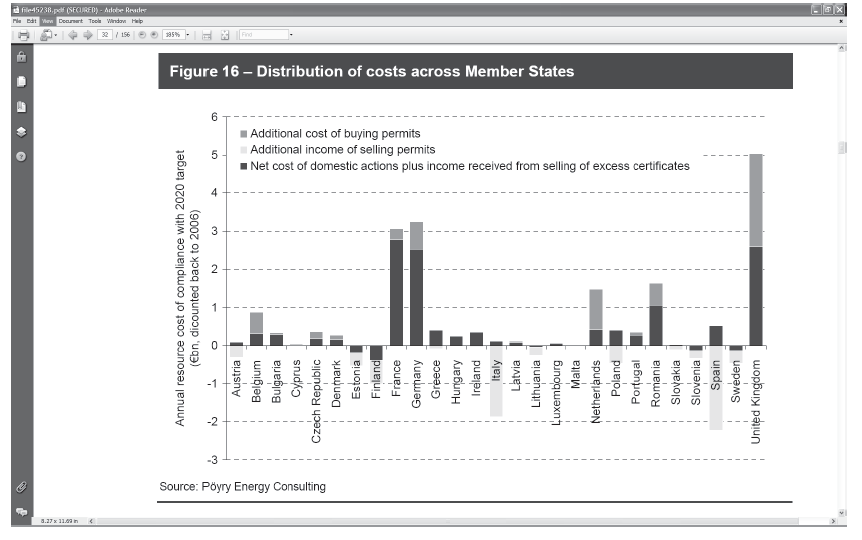
— As the UK's target is one of the
largest increases in renewable energy, the achievability of the
target is questionable. The Poyry analysis assumes that about
half of the UK's target would be achieved by purchasing Guarantee
of Origin certificates, which means that half of the UK's target
is dependent on investment, planning, and regulatory decisions
taken in other Member States.
— CBI's objectives are for the Directive
to be implemented at least cost and utmost flexibility.
(ii) How coherent are these proposals
in the context of the EU's energy policies in general and the
Third Energy Package in particular?
— A liberalised, competitive, interconnected
EU energy market will help the EU face the growing challenges
of energy security, carbon abatement and business competitiveness.
The CBI therefore strongly supports the thrust of the Third Energy
Package.
— Improving European energy markets
and building more electricity interconnections may allow electricity
demand patterns and renewable resource availability to be balanced
in order to avoid building as much back-up capacity. Growing amounts
of renewable electricity may make intermittency more of an issue
that must be managed with greater interconnections, back-up capacity,
and demand response and energy storage technologies.
— If Member States are unable to reach
political agreement over the Third Energy Package or if the proposed
Directives are insufficiently implemented then the European Union's
commitment to joint energy policy may be questionable.
— CBI proposes that the results of
the 3rd Energy Market Package be reviewed in several years and
the Renewable Energy targets be adjusted (or timelines extended)
if there is in-sufficient improvement in cross-border energy cooperation
and investment.
(iii) To what extent are these targets
capable of improving the EU's security of energy supplies?
— As the UK's target is expected to
be met largely with wind power there are likely to be intermittency
concerns when there is more than 20% wind on the grid. This may
require higher levels of grid back-up services from natural gas
combined cycle plants, so that the contribution to security of
supply is limited.
GRID ACCESS
(iv) While grid access is an important issue,
CBI does not have particular comments on the Committee's questions
in this section.
SUPPORT SCHEMES
(v) At what level should the EU be
involved in harmonising or regulating support schemes offered
by Member States to encourage renewable energy generation?
— The many different, uncoordinated
subsidy mechanisms in EU Member States may lead investments to
chase favourable incentives instead of where the most renewable
energy can be produced.
— CBI supports the UK Renewables Obligation
as it set the "rules of the game" for promoting investment.
— CBI supports the European Commission's
"Staff Working Document"[2]
conclusion that "it is currently inappropriate to harmonise
European support schemes".
— Price based (feed-in tariff) and
quantity based (Renewables Obligation) systems are equally valid.
Attempting to harmonise schemes may make it difficult to differentiate
between different technologies and different costs in different
countries. Technology cost differentiation is an aim of "banding"
provisions in the Energy Bill).
— Encouraging the EU to begin a process
of harmonising support schemes would introduce significant uncertainty
for renewable energy companies that would significantly slow investment.
— Over the long-run there may be a
case for harmonisation, perhaps following the Commission's suggested
"bottom-up" approach of aligning regional green certificate
or feed-in tariff schemes.
21 April 2008
1 http://www.berr.gov.uk/files/file45238.pdf Back
2
http://ec.europa.eu/energy/climate_actions/doc/2008_res_working_document_en.pdf Back
|


