Memorandum by the UK Business Council
for Sustainable Energy
INTRODUCTION
The UK Business Council for Sustainable Energy
brings together the key players[16]
in the energy sector to develop an effective dialogue with Government
that can help strengthen the UK's strategic agenda for sustainable
energy.
The activities of the companies that support
the Council collectively span generation, transmission and distribution,
and supply of energy. As a result, Council members are well positioned
to provide insights into the effective delivery of the EU renewable
energy target in the UK.
The Council believes that there is a crucial
role for renewable energy in delivering secure and low-carbon
energy supplies in the UK, and we welcome the Government's commitment
to supporting the appropriate development of the UK's renewable
energy resources.
Energy companies are keen to play their part
in delivering low carbon energy supplies, including renewables,
and are committed to working with Government and others to ensure
that the right support mechanisms are in place, and that key barriers
are addressed.
The purpose of this paper is to:
— present the Council's initial thinking
about the implications of delivering a 15% renewable energy target
in the UK by 2020, with a particular focus on renewable electricity,[17]
including:
— the anticipated mix of renewable
electricity technologies in 2020;
— wider implications of meeting the
target on the electricity system;
— outline key "no-regrets"
measures that should be implemented immediately to facilitate
progress towards the target; and
— highlight a range of issues that
the Council believes would benefit from further consideration
in developing the Government's Renewable Energy Strategy.
KEY POINTS
Importance of renewables: The Council
believes that there is a crucial role for renewable energy in
the UK in: delivering greenhouse gas emission reductions; reducing
reliance on energy imports; and potentially reducing exposure
to fuel price volatility. In addition, increased investment in
renewable energy is anticipated to deliver expanded business opportunities
along the renewable energy supply chain.
Stable long-term policy framework: Action
by Council members will underpin the bulk of delivery of the UK's
renewable energy targets. We are therefore keen to work with Government
to help develop a clear and stable policy framework that supports
the efficient and cost-effective delivery of renewable energy
in the UK.
Timely action: Delivering the UK's share
of the EU Renewable Energy target will be challenging, but we
believe it is achievable, provided that the Government does act
in a timely manner to ensure the right support mechanisms are
in place, and that current barriers, such as planning and grid
access, are fully and effectively addressed.
Cost: Delivery of the renewable energy
target will have significant cost implications for consumers.
This is in the context of the Stern Review, which found that moving
to a low carbon economy will require significant additional investment
in low carbon energy supplies including renewables in order to
avoid the costs associated with climate change. It is critical
that these costs are understood, and communicated to consumers,
and should form a significant part of the consultation on the
Renewable Energy Strategy. Achieving a response that does not
have a disproportionate impact on low-income households will be
a crucial test for public policy in this area.
Importance of energy efficiency: Energy
Efficiency has a critical role to play in reducing the amount
of renewable energy required to meet the target, and therefore
the overall costs. Council members have a strong and important
role to play in securing the uptake of energy efficiency measures,
and we are currently working with Government to help inform key
policies, such as the Supplier Obligation, as well as other areas
such as the Zero Carbon Homes, and wider energy efficiency measures.
Network implications: The Council's initial
view is that by 2020 around two-thirds to three-quarters of the
new renewable electricity generation capacity could come from
offshore and onshore wind energy. This will have implications
for the supporting infrastructure needed to maintain energy system
stability, including securing sufficient generation capacity to
manage intermittent supply from renewables.
Network investment: There is a need for
significant investment in the network infrastructure to manage
the increased contribution from renewable energy, and to manage
the associated peak capacity and operational and system stability
issues. Innovative approaches to optimising use of present network
assets as well as network expansion will need consideration, together
with related regulatory questions.
Microgeneration: The Council expects
to see a significant increase in microgeneration capacity, particularly
for heat-based technologies.
Bioenergy: The extent to which bioenergy
will contribute to the delivery of the target will depend on the
availability, cost and sustainability of biomass resources.
Trading: The Council believes there is
a potential role for trading within Europe to encourage the cost-effective
delivery of the renewable energy target. However, when looking
at the detail of how trading might be implemented, it is important
to note that a system that allows the UK to buy in a significant
amount of renewable energy credits from other countries, may mean
that the UK will not be in a position to realise the full benefits
associated with meeting the renewable energy target, including
increased independence from imported fuels and associated price
volatility. Also, the current trading provisions in the draft
directive are, at present, unlikely to deliver enough clarity
for developers in sufficient time to enable significant trading
before 2020.
Consultation: It is important that the
consultation allows for consideration of priority areas to be
addressed to enable delivery of the 15% renewable energy target,
including:
— Longer-term development needs for
supporting network infrastructure:
— Managing the impact of intermittent
generation on the system:
— Storage and demand side management.
— Ensuring the technology supply chain
has the capacity to deliver.
— Ensuring sufficient skills.
— Addressing the public policy implications
of a significant increase of renewables.
— Understanding and properly communicating
the cost implications for energy consumers.
— Understanding the pathway to a low
carbon energy supply to 2050, including the possible role of emerging
technologies such as marine and use of low carbon electricity
for heating.
IMPORTANCE OF
TIMELY ACTION
Delivery of the 2020 renewable energy target
will require swift action to ensure that: the supporting infrastructure
is in place; planning decisions are made in a timely manner; and
that key issues such as technology supply chain constraints are
addressed.
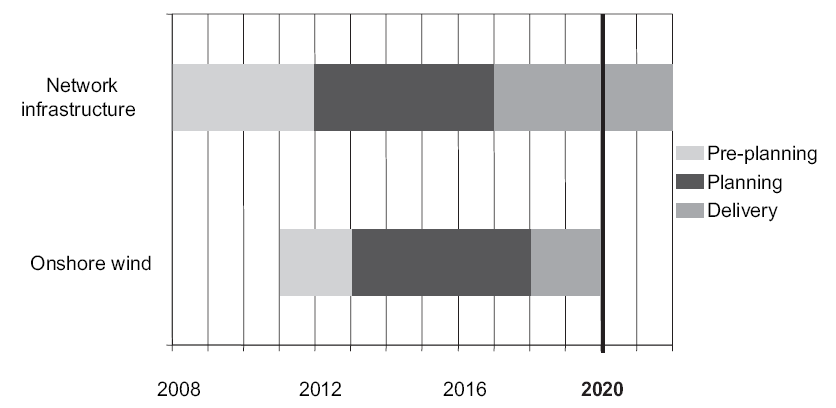
The following table summarises the indicative
times associated with the pre-planning, planning and delivery
phases of new wind and transmission infrastructure projects.
Table 1
INDICATIVE TIMING OF NEW WIND AND TRANSMISSION
INFRASTRUCTURE PROJECTS
| Pre-planning |
Planning process | Delivery
|
| Onshore wind | 2 years
| 5 years | 2 years |
| Transmission | 3-4 years |
5 years | 2-4 years |
As the following indicative timeline shows, new renewable
projects, and the associated infrastructure, must be initiated
in the next few years in order to make a significant contribution
to the 2020 targets.
Figure 1
INDICATIVE TIMELINE OF NEW WIND PROJECTS AND TRANSMISSION
INFRASTRUCTURE[18]
This highlights the importance of making critical decisions
expeditiously, and not revisiting through a further round of lengthy
consultations those matters that are already in train. In particular,
energy companies are keen that the Government, in parallel to
the consultation on the Renewable Energy Strategy, maintains a
sharp focus on implementing the important initiatives that are
currently underway.
Network infrastructure
In addition to planning and construction for renewable energy
projects, there are also time implications of new network infrastructure,
including identifying Offshore Transmission Owners, coordinating
connection between offshore and onshore infrastructure, and then
construction.
It is therefore particularly important that investment in
necessary network infrastructure is facilitated in a timely manner
to ensure progress towards delivering the 2020 renewable energy
target can be made.
Planning Reform
The introduction of the Planning Reform Bill will be critical
to facilitating the uptake of renewable energy projects and the
associated transmission infrastructure in a timely manner.
Under the current regime the planning process for a new onshore
wind farm can take up to five years.
It is important that planning solutions are also available
in the Devolved Administrations.
Support mechanism
The Government has a range of initiatives already in place
that are effectively encouraging the uptake of renewable energy.
For example, the Renewables Obligation has successfully underpinned
renewable electricity development in the UK, and is expected to
be a key support mechanism for onshore and offshore wind energy
and biomass projects.
The Council is also confident that a strong Government commitment
to a higher target and an extended time period for support for
renewable energy will continue to stimulate investment in renewable
electricity to 2020 and beyond.
We look forward to discussing with Government what other
support measures would be appropriate, particularly at the household
and smaller-scale level.
Beyond 2020
In addition to the challenge of meeting the 2020 renewable
energy target, the UK must also ensure the optimal delivery of
the right infrastructure for a low carbon energy system to 2050.
This will require a balance of implementing those "no-regrets"
measures that can facilitate the uptake of renewable energy in
the shorter-term to 2020, while ensuring that current activity
doesn't compromise the broader vision for low carbon and renewable
energy looking forward.
UK SHARE OF
THE TARGET
To meet its share of the EU renewable energy target, the
UK will need to deliver 15% of its energy from renewable sources
by 2020. An initial high-level assessment by the Council supports
the developing view that this could translate to:
— 10% of heat (an increase from less than 1% currently
by almost 70 TWh).
— 10% of land transport (an increase from less than
1% by over 45 TWh).
— Up to 40% of electricity from renewable sources
(an increase from less than 5% currently by over 125 TWh).
Assumptions on future energy demand
The 2020 projections for the amount of renewable energy to
be delivered across each sector are highly sensitive to the assumptions
made about demand growth.
The extent to which energy efficiency policies are implemented
in the UK will have a significant impact on the amount of renewable
energy that will be needed to meet the target. It is worth noting
that the biggest opportunity for energy efficiency is in reducing
heat consumption, and is less likely to impact on future demand
for electricity.
For illustrative purposes, the Council has looked at a scenario
where energy demand across heat, electricity and transport remains
at 2006 levels. While this does not reflect current and future
energy demand trends, or the impact of energy reduction policies,
this approach does provide a useful indication of the likely scale
of increase in renewable energy needed to meet the target, and
also provides some important insights into the implications for
the supporting infrastructure. The scenario that we have chosen
could act as a sound base case for projections going forward.
The Council can see that there could conceivably be an increased
pressure on the electricity sector to deliver more than 40% of
total electricity from renewable sources if:
— there is a significant increase in electricity
demand; and/or
— the heat and transport sectors do not achieve
their potential to use renewable energy.
For example:
— It is possible that we will see an increase in
demand for electricity in the UK if there is an increased use
of electricity for heating and transport, which will increase
the absolute volume of renewable electricity required.
— If policies to deliver renewables in the heat
and transport sectors are not as successful as hoped, then this
would also add pressure on the electricity sector to deliver the
renewables target. For example, current discussions about the
sustainability of biofuels could have an adverse outcome on the
deliverable proportion of transport fuels from renewables.
Table 2
BREAKDOWN OF EXPECTED HEAT, ELECTRICITY AND TRANSPORT
ENERGY CONSUMPTION BY 2020
| Consumption (TWh) | 2006
| 2020 (based on 2006 levels) |
| Electricity (conventional) | 375
| 248 |
| Electricity (renewable) | 19 (4.8%)
| 145 (38%) |
| Total Electricity | 393
| 393 |
| Heat (conventional) | 730
| 661 |
| Heat (renewable) | 5 (0.6%)
| 74 (10%) |
| Total Heat | 735
| 735 |
| Land Transport (conventional) | 478
| 432 |
| Other Transport (conventional) | 173
| 173 |
| Land transport (renewable) (% of all land transport)
| 2 (0.4%) | 48 (10%) |
| Total Transport | 653
| 653 |
| Total Energy (conventional) | 1,755
| 1,514 |
| Total Energy (renewable) | 25 (1.4%)
| 267 (15%) |
| Total Energy | 1,781
| 1,781 |

Expected renewable electricity mix
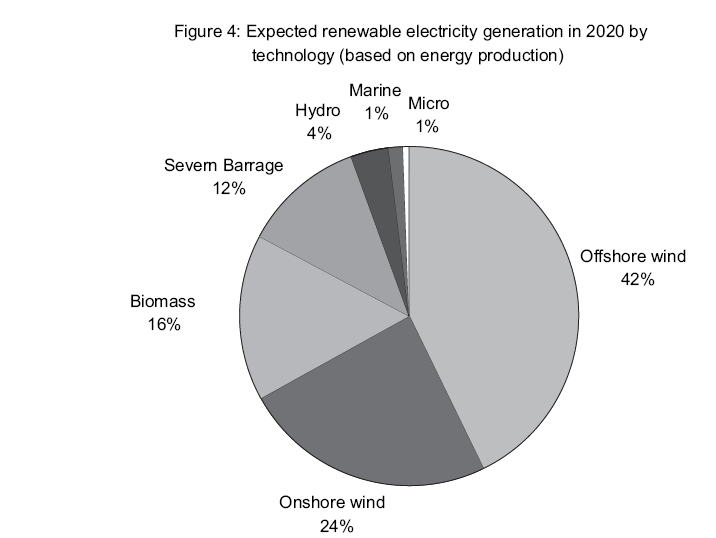
To deliver the target, it is expected that the UK will need
to generate a total of around 145 TWh of electricity from renewable
sources by 2020 (8% of total energy), from less than 20 TWh generated
in 2006.
The Council has made a preliminary estimate of the expected
technology mix that could make up the renewable electricity component
if it is delivered entirely in the UK. The Council expects that
the bulk of the new renewable electricity generation (over two-thirds)
is likely to come from onshore and offshore wind.
If Government believes that it is appropriate to create the
conditions in which a Severn Barrage might be built, the Council
does not anticipate that it could be delivered by 2020. However,
we understand that demonstrable progress towards delivering the
targets may be looked on favourably. We look forward to the outcomes
of the Government study into the feasibility of a tidal power
scheme in the Severn Estuary.
This project raises a number of important questions, including
its environmental impact, likely cost-effectiveness, the likely
subsidy-levels required, the relative economics of other low-carbon
investment. In reality, if the Severn Barrage (or a similar scale
development) was not delivered it would inevitable increase the
pressure to deliver more renewable electricity through other projects.
Table 3
EXPECTED RENEWABLE ENERGY MIX IN 2020: GENERATION AND
INSTALLED CAPACITY
| Technology | Generation (TWh)
| Total installed capacity (GW) | Load factor[19]
|
| Offshore wind | 62 |
25 | 0.28[20]
|
| Onshore wind | 35 | 14
| 0.27 |
| Biomass | 23 | 5
| 0.57 |
| Severn Barrage | 17 | 7
| 0.26 |
| Hydro | 5 | 2
| 0.35 |
| Marine | 2 | 1
| 0.30 |
| Micro/Small-scale | 1 | 1
| 0.10 |
| TOTAL | 145 |
55 | |
The load factors for offshore wind are based on BERR data
from existing projects. It is expected that, over time, the load
factor for offshore wind energy will improve as the technology
develops. This does highlight the importance of stimulating research
and development into better performing technologies that generate
more power from the available resources.
In developing this initial assessment of a possible renewable
electricity technology mix, we have compared notes with other
bodies such as the Renewables Advisory Board, and have found estimates
to be broadly consistent.
We welcomed the decision by Government to release the recent
Poyry report on "Compliance Costs for Meeting the 20%
Renewable Energy Target in 2020". However, a number of
questions arise from this report including:
— the assumptions about the scale of biomass implementation
which we believe do not fully reflect current concerns about the
cost, availability and sustainability of biomass; and
— some of the conclusions in the report related
to the outcomes of trading, which appear optimistic for 2020.
IMPLICATIONS OF
DELIVERING THE
RENEWABLE ENERGY
TARGET
Back-up plant and demand response
By 2020, we will need significant changes to the energy system
to ensure that it can manage the increased amount of intermittent
renewable energy electricity generation. The Council believes
that there will be a need for some form of backup for those times
when renewable resources are not available. This could take the
form of additional thermal supply capacity, or more innovative
approaches such as demand side management, or storage.
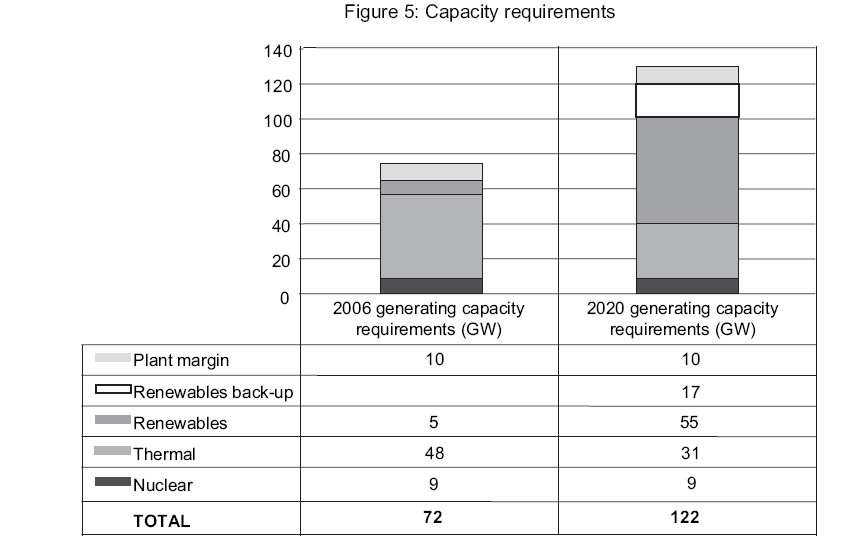
The UK currently requires around 72 GW of generating capacity
to meet energy demand.[21]
We currently have slightly more than that, with 76 GW of generating
capacity currently installed.
The Council estimates that at 2006 levels of energy demand,
a total installed capacity of over 120 GW would be needed, compared
to the 76 GW currently installed today. We estimate that the generation
mix in 2020 would include:
— 55 GW of renewable energy generating capacity;
— 31 GW of thermal plant; plus
— a further 17 GW of capacity to manage intermittency
at peak periods;[22]
and
— a further 10 GW of plant to provide a 20% margin.
Over the coming decade, as a result of the Large Combustion
Plant Directive, and plants coming to the end of their life, over
22 GW of existing power stations are expected to close by 2020.
Initial estimates indicate that this could result in a need for
around 68 GW of new build by 2020.
This also highlights the importance of considering the potential
role that storage and greater demand side management could have
in reducing the scale of investment in new supply needed.
The location of the necessary backup plant, and the capacity
of the network to allow connection will need further consideration.
This highlights a range of issues that we believe will
need consideration in the Renewable Energy Strategy, including:
— scale and location of back-up plant;
— capacity of the network to manage additional
plant;
— ability of current market mechanisms to encourage
sufficient and timely investment in back-up capacity;
— potential role of storage and greater demand
side management, and the policies and mechanisms needed to encourage
consideration of these alternative approaches;
— timeliness of investment for back-up facilities;
and
— the additional costs associated with providing
back-up services to the energy system.
Electricity transmission
Electricity transmission infrastructure will be key to enabling
the increased levels of renewable generation estimated above.
The three GB electricity transmission licensees that are members
the Council[23] provided
a preliminary view of the capacity of the existing GB transmission
system to accommodate new renewable generation without the construction
of new overhead line routes. An initial view was provided with
just the broadest of assumptions and without undertaking detailed
system studies. The following is a summary of the indicative guidance
from the three licensees.
Figure 6 below is intended to give a general indication of
the levels of renewable generation that could be accommodated
on the GB transmission system by 2020. It assumes completion of
transmission upgrades already in train (eg the Beauly-Denny rebuild
and south west Scotland works) as well as completion of those
works expected to be achieved without protracted planning issues,
eg relatively uncontentious re-conductoring and re-insulation
work on existing tower routes, and substation extensions.
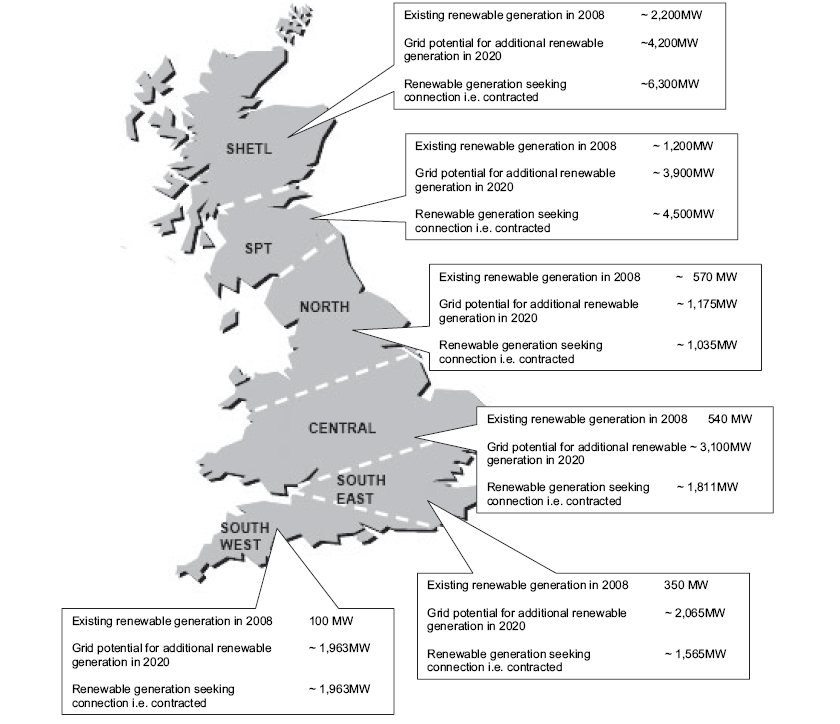
Table 4
LEVELS OF ADDITIONAL ENERGY GENERATING CAPACITY THAT COULD
BE ACCOMMODATED IN 2020 ABOVE EXISTING INSTALLED CAPACITY
| Region | Capacity (GW)
|
| Scotland | 8 |
| England and Wales | 8 |
| TOTAL | 16 |
There may be scope for this to be higher subject to further
examination of generation scenario assumptions in England and
Wales. However, this preliminary assessment highlights a significant
shortfall against the new renewable energy capacity needed to
meet the target.
The indicative numbers in Figure 5 are the result of a brief
assessment by the transmission licensees based on the following
high level assumptions and are not based on detailed study work.
Table 5
HIGH LEVEL ASSUMPTIONS USED IN ANALYSIS
| 1. Demand | Seven Year Statement user demand data extrapolated out to 2020.
|
| 2. Generation | Scotland: By 2020, no contribution from Hunterston or Cockenzie power stations. All other Scottish generation still contributing. England and Wales: All contracted generation proceeds and no closures (apart from Magnox nuclear and LCPD opted-out plant).
|
| 3. Planning Standard | Apply current GB SQSS
|
The intention is to give an indication of the potential for
the EXISTING GB transmission system in 2020 (ie including
upgrades that do not carry a high consenting risk) to accommodate
additional renewable generation, and for that number (approximately
16 GW) to be set against the Council's estimate of the additional
generating capacity that we anticipate will be needed to contribute
to meeting the 15% overall target for renewable energy.
While there is considerable capability in the potentially
achievable 2020 transmission system there is still nevertheless
a substantial shortfall compared with what would be consistent
with the 15% renewable energy target.
Our initial analysis indicates that we will need around 50
GW of additional energy generating capacity to meet the renewable
energy target, in various sizes and locations.
Overall, with around 16 GW of existing capacity, it is expected
that around 34 GW of additional transmission capacity will be
needed to manage the increase in renewable generating capacity
and associated back-up.
Detailed and coordinated study work by the three transmission
licensees is required to identify appropriate reinforcements to
deliver a transmission system capable of accommodating the total
55 GW of renewable generation we expect will be needed in 2020.
In particular, this work would quantify the costs and benefits
of various transmission options (see indicative unit costs below).
Table 6
COSTS OF TRANSMISSION OPTIONS
| Technology | Cost (£ per MW of rating per km)
|
| Onshore 400kV AC overhead line |
200 |
| Sub-sea HVDC cable | 1,000 |
| Onshore 400kV AC underground cable | 2,700
|
The Council is aware of previous coordinated studies (Renewable
Energy Transmission Studies (RETS) I and II[24])
undertaken by the three transmission licensees prior to 2005 with
sponsorship by DTI (at the time).
The Council believes that a similar approach is again appropriate
now. The Council therefore supports the initiative by National
Grid Electricity Transmission (NGET) and the Scottish transmission
licensees to re-establish a RETS group with appropriate sponsorship
by BERR that also brings together other interested parties, especially
generators to determine optimum reinforcements for future requirements
where options would include new onshore and offshore circuits.
The Council is happy to facilitate cross-industry work in this
area.
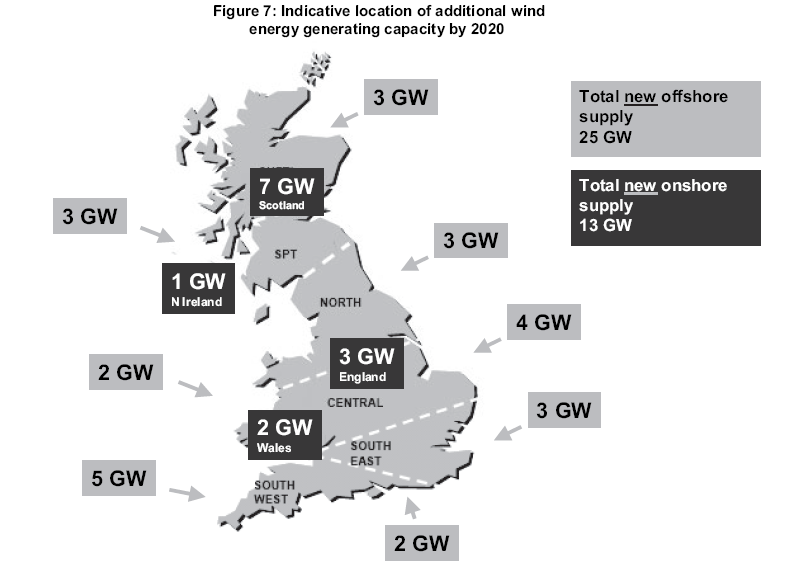
The Council has provided its estimates for how new wind generation,
in addition to that already installed, will be distributed around
the UK for inclusion in the background for such a study.
Table 7
INITIAL VIEWS ABOUT THE LOCATION OF ADDITIONAL WIND ENERGY
GENERATING CAPACITY BY 2020
| Offshore wind | Newcapacity (GW)
| Onshore wind | New capacity (GW)
|
| Scotland E | 3 |
Scotland | 7 |
| North E | 3 | Wales
| 2 |
| North W | 3 | Northern Ireland
| 1 |
| Central E | 4 | England
| 3 |
| Wales | 2 | TOTAL
| 13 |
| South East | 3 |
|
| South West | 5 |
| |
| South | 2 |
| |
| TOTAL | 25 |
| |
The Council also made the following observations on the indicative
guidance provided by the three transmission licensees.
— The consenting and completion of the Beauly-Denny
transmission rebuild is essential to releasing the upgrade potential
of the existing Scottish transmission system. By rebuilding the
weakest leg of a north of Scotland transmission ring it allows
the other elements of that ring to be re- conductored and re-insulated
(ie no new overhead line routes) to increase the capability for
renewable generation in the north to some 6.4 GW (around 2.2 GW
already connected). The reinforced ring facilitates collection
of the output from onshore developments and the sub-sea island
links are planned for connection onto the reinforced transmission
ring.
— Scottish Power Transmission (SPT) and NGET have
programmes of reinforcements including re-conductoring and the
use of innovative transmission devices to maximise the capability
of existing Anglo-Scottish circuits and those further south.
— Indications are that with appropriate funding
mechanisms to enable the transmission works to progress, especially
pre-application, environmental studies and design, as well as
with appropriate access and charging arrangements to ensure they
are fully utilised, the transmission works in hand should be capable
of accommodating some 16 GW of renewable generation in 2020. Independently
of longer-term review of transmission arrangements, it is essential
that these shorter-term measures are initiated and completed swiftly
otherwise delivery of sufficient infrastructure capacity to support
the 2020 target will be unachievable.
LOOKING FORWARD
In this submission we have outlined initial thinking about
renewable energy potential to 2020 for the UK.
Clearly, targeted policy intervention will be needed to deliver
the 2020 target.
Maintaining momentum
In the immediate term, we believe that there are a number
of measures in train that are critical to delivery of the target,
and it is important that the Government maintains a focus on implementing
these, such as the current planning reforms, and the new arrangements
for the Renewables Obligation.
Short-term "No-Regrets" measures
The Council also believes that there are potentially a number
of "no-regrets" measures that Government could implement
immediately to facilitate progress towards the target, including:
— demonstrating commitment across all Departments
to delivering the 2020 target;
— demonstrating Government commitment to continue
its policies and measures designed to support renewable energy
in order to ensure investor confidence is maintained;
— ensuring that in any revision of the existing
statutory social and environmental guidance to Ofgem, Government
gives a clear indication of the importance of Ofgem's role in
facilitating sustainable energy development;
— swift resolution of shorter-term transmission
access reforms to enable full use of existing transmission infrastructure,
and use of new transmission infrastructure as it is established;
and
— early resolution of the Government's and EC's
position on the use of biomass and biofuels across heating, electricity
and transport.
A key area of focus must be realising opportunities to encourage
timely new investment in the relevant transmission infrastructure.
We have seen a new process of strategic planning for renewable
energy in Scotland which has brought together input from industry,
regulators and planning to inform the National Planning Framework
for Scotland (see Figure 7). This could be usefully extended through
the anticipated new system of National Policy Statements—in
particular those for Infrastructure and Renewables. At a very
generalised level, this would identify the likely renewable energy
input, possible locations, and potential transmission upgrade
requirements.
Emerging issues for further consideration
This paper provides a very high level assessment of the implications
of delivering the renewable energy target in the UK. We have identified
priority areas basic to delivery of the 15% renewable energy target,
and on this basis we would hope to see the consultation on the
Renewable Energy Strategy give full consideration to the following
areas:
— Longer-term development needs for supporting network
infrastructure:
— Ensuring the supply chain can deliver.
— Ensuring sufficient skills.
— Managing and communicating public acceptance of
a significant increase of renewables.
— The technology, scale and location of peaking
plant.
— The role of demand side management and storage
to balance an increased proportion of intermittent generation.
— The extent to which trading between Member States
will be facilitated.
— The use of renewable electricity for heat and
transport.
— The materiality of the of cost of implementing
the renewable energy target for consumers.
— The uncertainties around the cost, availability
and sustainability of biofuels, and how any shortfall in the biofuels
area would be made up across the other sectors.
— The range of energy demand projection scenarios
looking forward, and the implications for the renewable energy
targets, including possible trends for an increased use of electricity
for heating and transport.
CONCLUSION
The Council welcomes the Government's commitment to increasing
the uptake of renewable energy in the UK, and we look forward
to participating in the upcoming consultation on the Renewable
Energy Strategy.
The 2020 renewable energy target is challenging. Delivering
this target will require clear, effective and decisive action
by Government to ensure a stable and supportive investment climate
for renewable energy.
To give the UK the best opportunity to deliver the 2020 target,
we believe that the Government should:
— drive the initiatives currently underway, including
delivering the new arrangements for the Renewables Obligation
and maintaining momentum on planning reform. Development and effective
implementation of the National Policy Statements for Renewables
and for Infrastructure will also prove central;
— quickly implement the "no-regrets" measures
that do not require significant further consultation, such as
strategic planning for the transmission infrastructure; and
— ensure that the consultation for the Renewable
Energy Strategy is prioritised to focus on areas that require
further examination.
The Council looks forward to continued dialogue with the
Government, Devolved Administrations and others.
1 May 2008
16
Members of the Council include Centrica, EDF Energy, E.ON UK,
National Grid, RWE npower, Scottish and Southern Energy, Scottish
Power, and United Utilities. Back
17
The Council has separate but related work streams on energy
efficiency and demand reduction, as well as the progressive decarbonisation
of the UK heat market. Back
18
This timeline is indicative, and clearly different projects
will have different commencement and completion dates. Back
19
From BERR Energy Statistics, Capacity of, and electricity generated
from, renewable sources-2006 figures used. Back
20
This reflects the load factor of current offshore wind farms
that are in the commissioning phase. In the longer-term, we expect
the load factor for off-shore wind energy to be higher, which
means that delivering the target would require a lower installed
capacity of offshore wind energy than our initial assessment (based
on our assumptions about demand for the purposes of this paper). Back
21
This includes an additional 20% capacity of the total thermal
capacity that would be needed to deliver the electricity demand. Back
22
This calculation assumes that the 55 GW of renewable energy
will deliver 10% firm capacity. Back
23
Scottish Hydro Electric Transmission Limited (SHETL), SP Transmission
Limited (SPT), and National Grid Electricity Transmission Limited
(NGET). Back
24
Studies included: Connecting Renewables to the Grid-A Report
by the Transmission Working Group of the Department of Trade &
Industry, November 2005. Back
| 


