Memorandum by the Renewables Advisory
Board
1. INTRODUCTION
The EU has proposed that the UK increase the
proportion of its energy use provided from renewables to 15% by
2020. The current percentage is less than 2%. RAB has been asked
to advise on policy issues and the potential for UK wealth creation
and jobs related to achievement of this target.
2. RAB's strategy has been to develop its
vision of the 2020 renewables market and then address the many
policy issues which will need to be implemented if that vision
is to be realised. This note outlines RAB's 2020 Vision and identifies
some of the most important issues that need to be tackled, many
urgently. Much further work is underway addressing individual
policy topic.
3. UK RENEWABLE
ENERGY SECTORS
We have divided the UK's renewable energy use
into four categories as follows:
| BULK ELECTRICITY |
BULK HEAT |
| — Onshore wind | — Industrial scale
|
| — Offshore wind | — Biomass heat & CHP
|
| — Dedicated biomass & CHP
| — Solid recovered fuels
|
| — Co-firing |
|
| — Landfill gas |
|
| — Anaerobic digestion |
|
| — Solid recovered fuels
| |
| — Hydro |
|
| — Tidal stream and Barrages
| |
| — Wave |
|
| — Severn Barrage |
|
| BULK HEAT | TRANSPORT |
| — Photovoltaics | — RTFO from 2010
|
| — Biomass CHP | — EU Directive from 2020
|
| — Biomass boilers |
|
| — Heat pumps |
|
| — Solar thermal |
|
| — Micro-wind |
|
| | |
4. Biomass presents particular modelling problems since
the available fuel supply will be limited, but its use is possible
in all four sectors. RAB believes that Government needs to make
a strategic decision on the optimal usage for biomass within the
UK.
5. CURRENT POLICIES
To assess the size of the challenge RAB firstly estimated
how much renewables can be expected to deliver by 2020 if current
policies eg Renewables Obligation, RTFO, Round 2 offshore wind,
remain unaltered. Our best estimate is that the UK will achieve
about 6% of our energy from renewables in our "business as
usual" scenario. We note that this figure is similar to other
recent studies.
6. It should be noted that we have forecast total UK
energy use in 2020 will be 150Mtoe; this includes a reasonably
aggressive assumption about future energy savings. In what follows
figures are reported as percentages of this figure: for instance
the 15% target equates to 22.5Mtoe; a value of 7.5% would fulfil
half of the 2020 target.
7. 2020 VISION
Expert groups in each of the four sectors were asked to predict
what could be delivered by 2020 with significant but achievable
policy changes. In each case the groups emphasised that business
as usual, or a small extension of it, would fall well short of
the target.
8. If the 15% target is to be approached we need to establish
a different energy world with new policy, economic and social
drivers. Many of these changes will need to be radical and will
require, above all else, political leadership and a determination
to succeed. RAB believes that public concerns about climate change,
fuel imports and energy price volatility make radical political
action deliverable. Industry and commerce themselves stand ready
to deliver but, as ever in the renewables industry, the greatest
investment risk is seen as political risk. Investors need to be
confident that government is determined to achieve its own targets.
9. In total the expert groups felt able to forecast that
14% of UK energy could be provided by renewables provided that
a set of identified policy changes could be implemented in good
time. We have called this our "base case". RAB further
identified three more challenging alternatives which could close
the gap to 15%; indeed it may be prudent to aim for a figure somewhat
higher than 15% to accommodate possible failure or slippage. See
figure 1.
The following sections provide details for each sector.
10. BULK ELECTRICITY
11. Vision
Constraints on the volumes of renewables that can be delivered
in both the Transport and Heat sectors (see later sections) require
Bulk Electricity and the Built Environment to provide a large
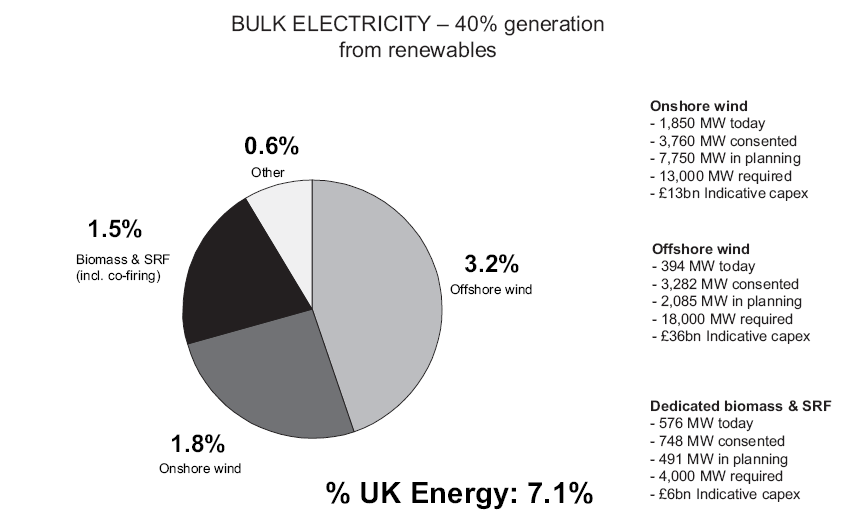
part of the 15% target. In our base case 2020 vision 7.1% of energy
will be provided from the Bulk Electricity market. This equates
to approximately 40% of the grid-connected electricity market;
this compares with less than 5% today and the current Renewables
Obligation target of 20% by 2020.
12. Three technologies are predicted to dominate the
2020 renewable electricity market: onshore wind, offshore wind,
and biomass with solid recovered fuels (waste). See figure 2.
The size of the challenge may be judged from the following table.
| Bulk Electricity | Onshore Wind
| Offshore Wind | Dedicated Biomass & SRF
|
| Installed today MW | 1,850
| 394 | 576 |
| Already consented MW | 3,760
| 3,282 | 748 |
| In planning MW | 7,750 |
2,085 | 491 |
| % UK Energy by 2020 | 1.8
| 3.2 | 1.3 |
| Total MW req'd by 2020 | 13,000
| 18,000 | 4,000 |
| Indicative total capex £bn | 13
| 36 | 6 |
13. On average we need to install slightly less than
1GW per annum of onshore wind, 1.5 GW per annum of offshore wind,
and 250MW per annum of biomass and SRF. For comparison, over the
next five years, Spain is expected to install 2.5GW per annum
of wind and France and Germany 2GW per annum each (ref BTM Consult).
14. Other renewable technologies are expected to provide
a total of 0.6% of UK energy. These include landfill gas, digesters,
hydro, smaller barrages, wave and tidal. The UK leads the world
in the development of wave and tidal power devices and RAB supports
ongoing support for these technologies; their UK contribution
by 2020 is estimated to be at most 1GW but rapidly followed by
very significant worldwide growth around that time.
15. The Severn Barrage has not been included in our base
case. RAB awaits the outcome of the current review. It has been
included as one of our "more challenging" options for
closing the gap to 15%. We understand that, if completed early
in the 2020s, under the currently proposed EU rules half of its
capacity could be attributed to the target; this would be about
0.6% of UK energy.
16. Policies
Given the size of the contribution expected of Bulk Electricity
it is vital that current obstacles to rapid growth are removed.
RAB will report later in more detail on many of these policy issues.
For the timebeing we highlight just some of the highest priority
and most urgent issues which must be resolved:
— Urgent Grid Studies: Development of large
capacities of onshore wind in Scotland, Wales and NI will require
substantial grid reinforcement. Equally connection of a further
15GW of offshore wind, much of it off the East Coast, will require
design, planning and construction of several new 400kV transmission
lines onshore. Recent experience indicates that typically this
takes 10 or more years; we are relying on the recently announced
IPA to reduce this period. Nevertheless RAB believes that strategic
grid studies must commence immediately and that regulatory barriers
to funding of this work removed; arguably we are already starting
too late.
— Planning and Radar/Aviation: The ongoing
problems of gaining planning consents, particularly for wind farms,
are well known and will continue to be addressed by RAB separately.
Nevertheless the recent last minute objections to both on- and
offshore projects due to radar difficulties are precisely the
form of policy instability which seriously undermines investor
confidence. It is RAB's belief that there are technical solutions
to radar problems, that these should be proven, and the issue
of who pays for their implementation resolved; the cost is small
relative to the size of capital investment that industry is being
expected to make.
— Financial Support System: The Renewables
Obligation has proved a successful mechanism and RAB has supported
both its introduction and recent amendments. However it is designed
to encourage 20% renewable electricity and we are now seeking
to double that contribution. Within the next two years industry
will need a clear idea of what will follow the current RO. In
particular, investors need confidence that the renewables market
will support investments made between now and 2020 well beyond
the current RO mechanism which terminates in 2027.
17. BUILT ENVIRONMENT
18. Vision
Forecasting the 2020 contribution from renewables to energy
use within the Built Environment has proved the most difficult
challenge in developing this Vision. Whereas the rate of Bulk
Electricity growth is driven predominantly by government policies,
in the built environment we shall be reliant on uptake by very
large numbers of individuals, households and companies. These
are the same entities that have to date been relatively slow to
embrace energy efficiency measures despite reasonably strong economic
incentives.
19. The expert group made estimates on both bottom-up
and top-down bases. A wide range of figures emerged with those
working in the sector being more optimistic than the wider RAB
group. We have adopted a forecast of approximately 5 Mtoe or 3.3%
of total energy; this includes both heat and electricity, the
majority being heat.
20. RAB have divided properties within this sector into:
— Existing non-residential.
Given the uncertainty surrounding our forecast it is difficult
to predict the technology mix within this sector. However since
the size of an installation is relatively small the number required
is correspondingly large. The following table gives an indication
of size of the contribution to the 5 Mtoe target from each of
the sectors, and the breakdown of technologies and the number
of installations needed for the existing residential build sector
by 2020:
| Sector/Technology | Contribution (Mtoe)
| Typical single domestic production (MWh pa)
| Number of installations required (thousand)
|
| New build residential | 1.1
| | |
| New build non-residential | 1.0
| | |
| Existing build residential* | 2.2
| | |
| Of which: | |
| |
| Photovoltaics | 0.09
| 1.5 | 6801
|
| Solar Hot Water |
0.23 | 2.25 | 1,3002
|
| Micro-wind | 0.33
| 4/23 | 1,1703
|
| Air Source Heat Pump | 0.74
| 6 | 1,4404
|
| Ground Source Heat Pump | 0.81
| 10 | 9505
|
| Existing build non-residential | 0.7
| | |
| Total | 5 |
| |
* All analysis based on 26m existing homes
1 Approx 1 in 38 UK homes; this is approx.7% of 10 million
homes CLG estimate to be suitable for installation in "Review
of the sustainability of existing buildings", 2006.
2 1 in 20 UK homes; this is approx. 7% of 19 million homes
CLG estimate to be suitable for installation in "Review of
the sustainability of existing buildings", 2006.
3 15% of 5 million rural homes installing a system generating
4MWh per annum + 2% of 21 million urban and suburban homes installing
a system generating 2MWh per annum.
4 8% of 1.5 million gas boiler replacements made annually
installed with an air source heat pump.
5 15% of the 3.9m homes estimated to be off the gas grid,
+ 2% of 1.5m gas boiler replacements made annually.
21. The UK is starting from a very low base in this sector.
Germany, a country with a similar climate, is well ahead: supported
by a feed-in tariff there are nearly ½ million PV installations
providing 1GWp. Last year the UK installed 270 units; Germany
130,000.
22. Policies
In the Built Environment sector it will be necessary to transform
public behaviour. This is always challenging although we have
seen very substantial positive changes in public perceptions of
renewable energy in recent times.
24. It is possible to enforce change in the New Residential
and New Non-residential sub-sectors by regulation. The Government's
announcement of Zero Carbon standards for homes in 2016 and commercial
property by 2019 is welcomed and RAB have assumed compliance in
our 2020 Vision. This is forecast to provide about 2 Mtoe per
annum.
25. For existing buildings which will provide the remaining
3 Mtoe per annum, it will be necessary to use carrots rather than
sticks. We have identified a long list of policies designed to
induce investment by property owners and RAB will again be reporting
in greater detail later in the year.
26. As examples we highlight here just three policies
which RAB believes deserve immediate consideration:
— Statutory targets to give investor confidence
of new policy development if existing measures fail.
— Financial and fiscal strategy with significantly
stronger and better targeted incentives in a range of deployment
measures.
— Remaining regulatory barriers on planning and
certification to be solved.
27. BULK HEAT
28. Vision
The use of renewables to supply large quantities of heat
is effectively limited to burning of biomass and solid recovered
fuels, preferably in combined heat and power plants (CHP) associated
with heat networks or industrial loads. We have estimated that
0.9% points of the 15% target could be produced from this source.
29. Biomass and Solid Recoverable Fuels Policy
As mentioned earlier, RAB believe that Government needs to
follow up its recent review of Biomass resources with policy decisions
which will assign the available indigenous and imported fuel resources
to specific sectors. These policy decisions will need to take
account of:
— potential indigenous production of energy crops;
— expected availability of indigenous SRF;
— potential imports of biomass, recognising concerns
about sustainability, food production and global competition for
such fuels;
— the need to meet the separate EU 10% target for
road transport fuels;
— the carbon intensity and cost effectiveness of
different technologies; and
— the environmental impacts of the different options.
In terms of meeting the 15% target it is largely immaterial
which sectors benefit.
30. TRANSPORT
We have assumed that the RTFO of 5% biofuels by 2010 and
the EU target of 10% by 2020 will be implemented in full and that
vehicle technology will constrain development beyond these levels.
In 2020 2.7% points of the 15% target is expected to be contributed
by Transport.
31. "Further Stretch" Options
In Section 3 we noted that the sum of contributions from
the four sectors falls short of the 15% target by about 1% point.
RAB have identified three possible options to fill the gap but
stress that delivery of each will present further challenges beyond
already stretching aspirations. The three options are:
— Installation of the Severn Barrage, half of which
would count towards the 2020 target provided construction begins
before 2016.
— A further 6GW of wind power, mostly offshore,
bringing the total offshore capacity to about 24GW.
— A further 30% increase in energy production from
renewables in the Built Environment sector. This would need to
be retro-fitted to Existing stock, and would probably require
installation of district-wide heat networks.
32. SUPPLY CHAIN—OPPORTUNITIES
AND CHALLENGES
In order to achieve this vision the capital investment from
UK industry and property owners is expected to exceed £100
billion. It is imperative that the UK supply chain captures the
maximum value and creates the maximum number of "green collar"
jobs from this market.
33. Major opportunities are identified as follows:
| Technology | Expected Capital Investment by 2020, £ billion
| Major opportunities for UK business
|
| Offshore Wind | 36 | — Project development
|
| | — Foundations
|
| | — Installation, vessels, servicing
|
| | — Grid connections
|
| | — Turbines and components
|
| Onshore Wind | 13 | — Project development
|
| | — Civil engineering
|
| | — Installation, servicing
|
| | — Grid connections
|
| | — Components
|
| Bioenergy | 6 | — Energy crops and SRF
|
| | — Technology, infrastructure
|
| | — Transport
|
| Built Environment | 50* |
— Installation |
| | — Servicing
|
| Wave & Tidal | 3 | — Technology development
|
| | — Installation
|
| Financial Institutions | 100*
| — Investment |
| | — Re-financing, hedging etc
|
| * Indicative; very dependent on technology mix.
| |
34. In order to benefit from these opportunities the
supply chain needs to have confidence in the creation of a stable,
growing market. Once again this will depend above all else on
positive perceptions of political will and implementation of policy
frameworks.
35. The supply chain for renewables will be a global
competition: all EU nations will be pursuing similar ambitions
within their own 2020 targets. Other countries such as USA, China
and India will be developing their own technologies and many have
the advantages of cheaper labour costs. Nevertheless the UK leads
the world in some technologies, in our financial skills, and we
have some of the most abundant natural resources in our wind,
wave and tidal sectors.
36. To maximise our national share of wealth creation
from renewables we must:
— Create a stable, growing market.
— Build on our existing pool of appropriate skills.
— Be flexible in interpretation of EU Procurement
and State Aid rules.
37. KEY MESSAGES
— The 2020 target of 15% UK energy from renewables
is achievable ... BUT:
— This requires rapid development of a transformed
energy framework with radically new economic, political and social
drivers. Renewables must be at the heart of energy policy.
— Many new policies are required and some are very
urgent.
— UK industry has the resources and investment required,
provided it gains confidence in a stable, growing market.
— The prize for the UK industry is a substantial
share of UK capital investment totalling some £100 billion,
plus a share of a global market very many times as large.
Figure 1
CONTRIBUTIONS To 2020 TOTAL UK ENERGY BY %
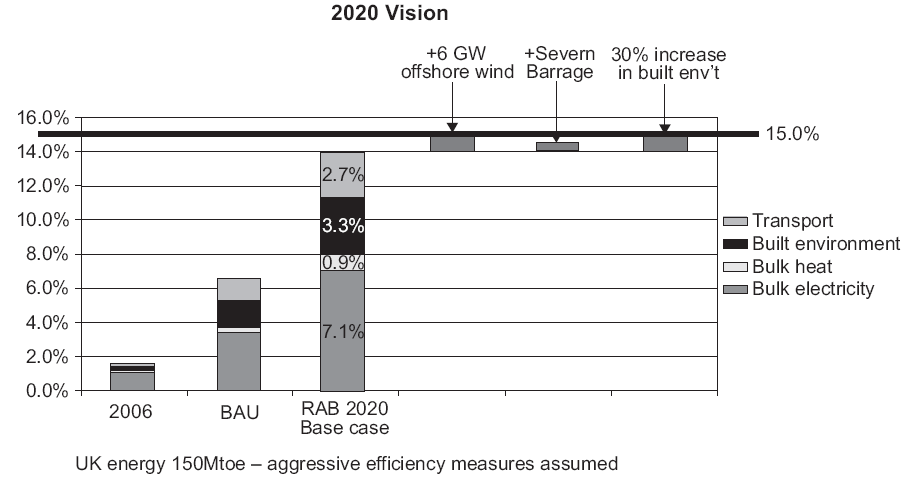
Figure 2
CONTRIBUTIONS TO 2020 BULK ELECTRICITY MARKET, TOTAL 7.1%
OF UK ENERGY OR 40% OF UK ELECTRICITY
24 April 2008
| 


