Memorandum by Scottish and Southern Energy
INTRODUCTION
Scottish and Southern Energy (SSE) is grateful
to have this opportunity to submit evidence to the Committee's
inquiry into the EU's 20% Renewable Energy Target. SSE is determined
to play its part in meeting the renewable targets and, already
the largest renewable generator, SSE has an internal company renewable
energy objective of 4,000MW set for 2013 in the UK and Ireland.
Over £2.5 billion capital investment will be made in renewable
energy in UK and Ireland up to 2013, with around £500m equity
investment in renewable energy in new markets and technologies
in the same period. It is also involved in the generation, supply,
transmission and distribution of electricity and in the supply,
storage and distribution of gas.
Looking forward, renewable energy has a vital
role to play in delivering secure and low-carbon energy supplies
in the UK. Put simply, the benefits of moving to a more renewables
based generation portfolio will allow the UK to benefit from reduced
greenhouse gas emissions; reduced reliance on energy imports,
particularly from unstable regimes; reduced exposure of the energy
system to fuel price volatility; and expanded business opportunities
right the way along the renewable energy supply chain.
That said, renewables alone are not the solution
to tackling Climate Change sustainably. Politicians, policymakers
and others should not underestimate the role that non renewable
low carbon generation can play in reducing global emissions, whether
through more efficient use of fossil fuels, nuclear new build,
or carbon capture and storage. If the world is to tackle Climate
Change, all low carbon generation will have to be considered as
part of the energy mix.
It is also vital to stress that overall energy
demand reduction will be crucial in tackling Climate Change and
meeting European energy targets. Successful demand reduction reduces
the overall scope of the challenge.
In this response, SSE has not responded to every
question posed but taken a whole-approach to what the targets
mean in practice, the implications for meeting the target and
what can be done to resolve the current barriers.
WHAT COULD
THE TARGET
LOOK LIKE
IN PRACTICE?
The UK share of the European target
To meet its allocated share of the EU renewable
energy target, the UK will need to deliver 15% of its energy from
renewable sources by 2020.
An initial high-level assessment, conducted
by SSE in partnership with the United Kingdom Business Council
for Sustainable Energy (UKBCSE) supports the developing view that
this could translate to:
— 10% heat (an increase of almost 70
TWh from current levels);
— 10% land transport (an increase of
over 45 TWh from current levels); and
— up to 40% of electricity from renewable
sources (an increase of over 125 TWh from current levels).
Modelling demand and consumption
For illustrative purposes, SSE has modelled
a scenario looking at the impact of the draft Renewables Directive
while assuming that energy demand across heat, electricity and
transport remains at 2006 levels. While this does not reflect
current and future energy demand projections, it provides an insight
into the scale of the increase in renewable energy needed to meet
the target, and the implications for the supporting infrastructure.
However, before analysing this information,
it is important to understand that the electricity sector may
have to deliver more than 40% renewable energy if there is a significant
increase in electricity demand; and/or the heat and transport
sectors do not realise their renewable energy potential. In addition,
as technologies develop, there is likely to be an increased pressure
on electricity demand created by the emergence of mains powered
electric cars, which would need to be charged up from buildings
overnight. In addition, given the lack of any Government policy
on incentivising renewable heat, assuming a constant electricity
demand and a significant contribution from renewable heat or transport
is far from certain.
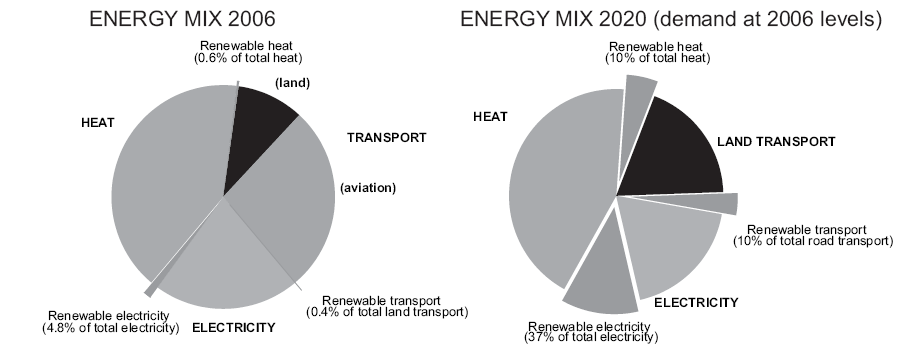
Anyway, while assuming a demand level based
on 2006 for 2020, the below table shows the breakdown of expected
heat, electricity and transport energy consumption by 2020
| Consumption (TWh)
| 2006 | 2020 (based on 2006 levels)
|
| Electricity (conventional) | 375
| 248 |
| Electricity (renewable) | 18.78 (4.8%)
| 145 (36.9%) |
| Total Electricity | 393 |
393 |
| Heat (conventional) | 730 |
661 |
| Heat (renewable) | 4.52 (0.6%)
| 73.5 (10.0%) |
| Total Heat | 735 | 735
|
| Land Transport (conventional) | 478
| 432 |
| Other Transport (conventional) | 173
| 173 |
| Land transport (renewable) (% of all land transport)
| 2.09 (0.4%) | 48 (10.0%) |
| Total Transport | 653 | 653
|
| Total Energy (conventional) | 1,755
| 1,514 |
| Total Energy (renewable) | 25 (1.4%)
| 267 (15.0%) |
| Total Energy | 1,781 | 1,781
|
This information is displayed below graphically:
Expected renewable electricity mix
To deliver the target, it is expected that the UK will need
to generate a total of around 145 TWh of electricity from renewable
sources by 2020, from less than 20 TWh generated in 2006.
SSE has made a preliminary estimate of the expected technology
mix that could make up the renewable electricity component if
is delivered entirely in the UK. SSE expects that the bulk of
the new renewable electricity generation (around 75%) is likely
to come from onshore and offshore wind. This information is displayed
graphically below:
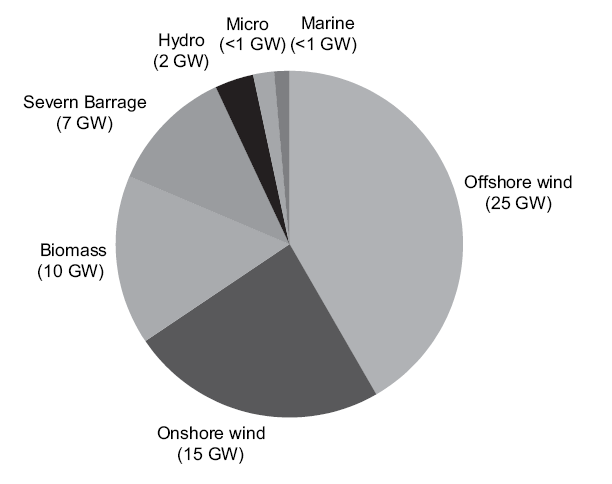
SSE does not expect that the Severn Barrage could be delivered
by 2020. However, we understand that demonstrable progress towards
delivering the targets will be looked on favourably, so have included
it in projections. If the Severn Barrage does not get built, wind
will likely fill the gap.
IMPLICATIONS OF
DELIVERING THE
RENEWABLE ENERGY
TARGET
The above information gives us an idea of where the UK needs
to be, but the key is, of course, how to get there, and whether
it is possible to get there, and in time. In the following section,
SSE addresses the barriers that need to be overcome in order to
achieve these targets. However, before doing this it is necessary
to stress that without the bulk of the following barriers being
overcome, the UK will not reach these targets.
Renewables Obligation
The Government has a range of initiatives already in place
that are making progress in encouraging the uptake of renewable
energy. For example, the Renewables Obligation (RO) has successfully
underpinned renewable electricity development in the UK, and will
continue to be the key support mechanism for onshore and offshore
wind energy and biomass projects, and possibly marine projects
in due course. SSE is also confident that the RO, with a higher
target, and extended time period, will be an effective mechanism
to stimulate investment in renewable electricity to 2020 and beyond.
However, the key is for Government to refrain from excessive tinkering
with the RO, in terms of banding and other parts of its operation.
Investor confidence is paramount for this mechanism to work long
term.
Planning
The current planning system takes too long and is applied
inconsistently and unpredictably, undermining the UK's ability
to address the challenges of security of supply and climate change.
While we clearly do not expect a positive decision on all planning
projects, we feel it is essential that planning decisions are
made in a timely, transparent and accountable manner. With the
sheer amount of renewable infrastructure needed to meet the targets,
and the fact that wind will be responsible for achieving the bulk
of the 2020 targets, the current planning regime is, quite simply,
not fit for purpose.
For example, under the current regime, analysis we have undertaken
indicates that a new onshore wind farm could require around 2-3
years of preparatory work, and currently the planning process
can take up to 5 years, which will be followed by a further 1-2
years of construction. This does not take into account the time
associated with building new transmission infrastructure, which
could in parallel take 3-4 years preparation, plus 2-4 years to
construct, and again up to 5 years in planning.
As these indicative timescales show, new renewable projects,
and the associated infrastructure, must be initiated in the next
year or two in order to make a significant contribution to the
2020 targets. We should not revisit those matters that are already
in train through a lengthy consultation process, but ensure that
the critical decisions can be made expeditiously.
It is for the reasons outlined above that SSE has supported
the Government's Planning Reform Bill and believe that the Bill's
proposed approach is a potentially significant step in the right
direction, appropriately balancing concerns over environment,
the economy and local communities, while providing the required
level of expertise needed for ruling on these complex inquiries
through the vehicle of the Infrastructure Planning Commission
(IPC).
The reform package comprises enhanced community engagement;
the establishment of an independent Infrastructure Planning Commission
to determine all nationally significant infrastructure projects;
National Policy Statements setting out the policy framework against
which decisions should be made; and simplification of the energy
consents and the Town and Country Planning regimes.
Overall, the proposed system offers a better way of dealing
with applications to build key national infrastructure, at a time
when we need it most. There are still issues to be ironed out
in the Bill, such as the need for end to end timescales for applications,
and how the National Policy Statements will be applied in devolved
administrations (where much of the renewables capacity will likely
be located), but one thing is for certain: if the planning system
is not reformed adequately, the UK will not reach its renewable
targets.
NETWORK ISSUES
AND FLOWS
Electricity transmission infrastructure will be key to enabling
the increased levels of renewable generation estimated throughout
this response. Working with the UKBCSE, and the other two GB electricity
transmission licensees, SSE has examined the capacity of the existing
GB transmission system to accommodate new renewable generation
without the construction of new overhead line routes. This is
an initial view with just the broadest of assumptions and without
undertaking detailed system studies.
The diagram below is intended to give a general indication
of the levels of renewable generation that could be accommodated
on the GB transmission system by 2020. It assumes completion of
transmission upgrades already in train (eg the Beauly-Denny rebuild
and south west Scotland works) as well as completion of those
works expected to be achieved without protracted planning issues,
eg relatively uncontentious re-conductoring and re-insulation
work on existing tower routes, and substation extensions.
Capacity of the Transmission System to Accommodate Renewables
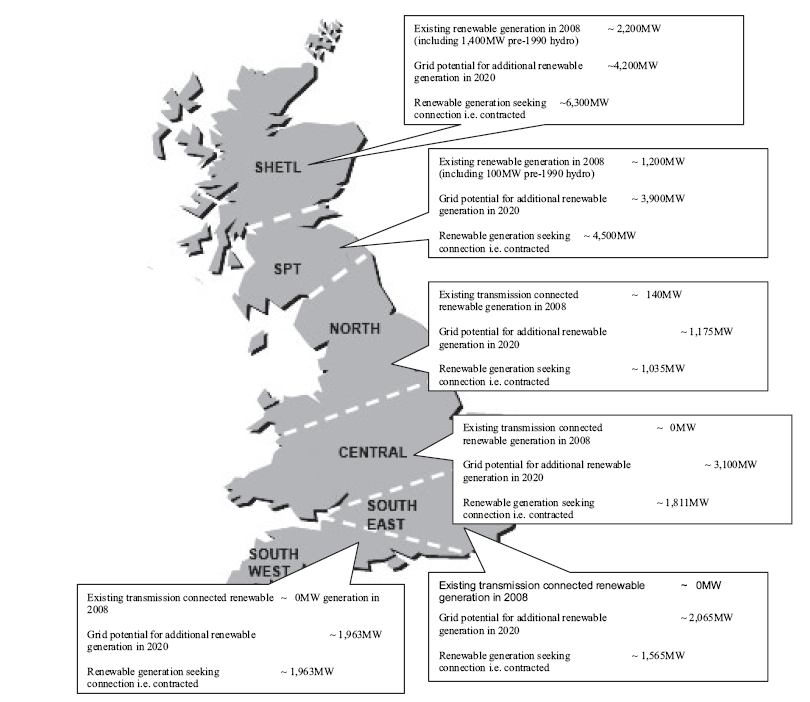
Levels of renewable energy generation that could be accommodated
in 2020
| Scotland | 10,000 MW[12]
|
| England and Wales | 8,300 MW
|
| Total | 18,300[13]
|
There may be scope for this to be higher subject to further
examination of generation scenario assumptions in England and
Wales. Rounding the indicative figure up to 20 GW for the amount
of renewable generation that could be accommodated in 2020 still
however highlights a significant shortfall against the likely
requirement for some 60 GW of renewable generation derived to
meet the 15% overall target.
High level assumptions used in analysis
| 1. Demand | Severn Year Statement user demand data extrapolated out to 2020.
|
| 2. Generation | Scotland: No contribution from Hunterston or Cockenzie power stations. All other Scottish generation contributory. England and Wales: All contracted generation proceeds and no closures (apart from Magnox nuclear and LCPD opted-out plant)
|
| 3. Planning Standard | Apply current GB SQSS.
|
The intention is to give an indication of the potential for
the existing GB transmission system in 2020 (ie including upgrades
that do not carry a high consenting risk) to accommodate additional
renewable generation, and for that number (approximately 20GW)
to be set against our estimate of the total volume of renewable
generation (some 60GW) that we anticipate will be needed to contribute
to meeting the 15% overall target for renewable energy.
While there is considerable capability in the potentially
achievable 2020 transmission system there is still nevertheless
a substantial shortfall compared with what would be consistent
with the 15% renewable energy target. Detailed and coordinated
study work by the three transmission licensees is therefore required
to identify appropriate reinforcements to deliver a transmission
system capable of accommodating some 60 GW of renewable generation
in 2020. In particular this work would quantify the trade-off
between more costly offshore transmission capacity versus more
onerous barriers to associated with new onshore transmission routes
(see indicative unit costs below).
In short, indications are that with appropriate funding mechanisms
to enable the transmission works to progress, and appropriate
access and charging arrangements to ensure they are fully utilised,
the transmission works in hand should be capable of accommodating
some 20GW of renewable generation in 2020. A co-ordinated study
by the three transmission licensees should be supported to identify
the further optimal reinforcements necessary to accommodate some
60 GW of renewable generation in 2020 and the future funding requirement
for those works should be recognised now.
However, SSE must stress that the consenting and completion
of the Beauly-Denny transmission re-build is absolutely key to
releasing the upgrade potential of the existing Scottish transmission
system. By rebuilding the weakest leg of a north of Scotland transmission
ring it allows the other elements of that ring to be re-conductored
and re-insulated (ie no new overhead line routes) to increase
the capability for renewable generation in the north to some 6.4GW
(cf 2.2GW already connected). The reinforced ring facilitates
collection of the output from onshore developments and the subsea
island links are planned for connection onto the reinforced transmission
ring.
Back-up plant and demand response
By 2020, we will need some changes to the energy system to
ensure that it can manage the increased amount of intermittent
renewable energy electricity generation. SSE believes that there
will be a need for some form of back-up for those times when renewable
resources are not available. This could take the form of additional
thermal supply capacity, or more innovative approaches such as
demand side management, or storage.
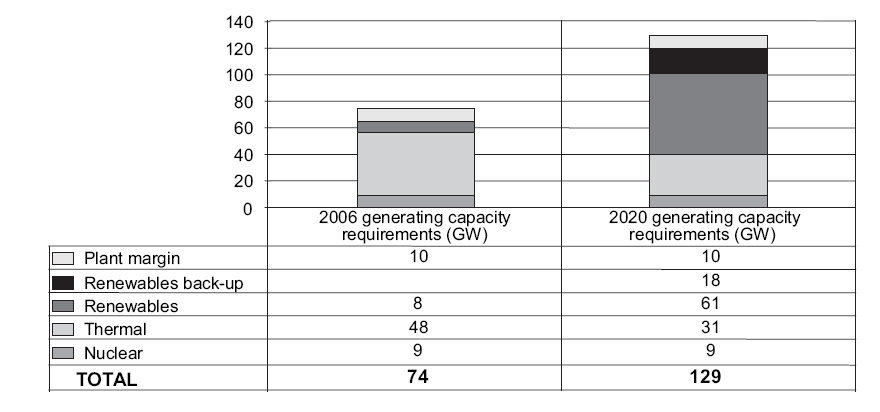
SSE estimates that at 2006 levels of energy demand, a total
installed capacity of 130 GW would be needed as against the 76
GW currently installed today. We estimate that 61 GW of renewable
energy generating capacity in 2020 would need to be supported
by:
— around 9 GW of nuclear plant, and 31 GW of thermal
plant to meet energy demand; plus
— a further 18 GW of capacity to manage intermittency
at peak periods; and
— a further 10 GW of plant would be needed to provide
a 20% plant margin.
The below diagram illustrates this data:
The UK currently has around 76 GW of electricity generation
capacity, which means that there is currently a healthy plant
margin. Over the coming decade, as a result of the Large Combustion
Plant Directive, and plants coming to the end of their life, over
22 GW of existing power stations are expected to close by 2020.
This could result in a need for 75 GW of new build by 2020.
The location of the necessary backup plant, and the capacity
of the network to allow connection need also to be considered.
The importance of reducing energy demand
As discussed earlier, the 2020 projections for the amount
of renewable energy to be delivered across each sector are highly
sensitive to the assumptions made about demand growth.
Although SSE will not focus on the detail in this submission,
the extent to which energy efficiency policies are implemented
in the UK will have a significant impact on the amount of renewable
energy that will be needed to meet the target. It is worth noting
that the biggest opportunity for energy efficiency is in reducing
heat consumption, and is less likely to impact on future demand
for electricity.
Addressing heat policy could be critical in meeting the targets
Given that heat is responsible for over 50% of energy usage,
compared to electricity being responsible for around 20% of energy
usage, for each extra percentage of heat we make from a renewable
source, we take 2.5% off the renewable electricity target we need
to get to in order to meet our European renewable targets. Given
that there is at present no incentive for encouraging renewable
heat but there is an Renewables Obligation (RO) for electricity,
SSE believes that the Government must take action quickly to change
this. While not wedded to a particular solution, SSE sees Government
action here as a real opportunity to ensure a fairer share of
the burden for heat, in line with that of electricity and transport.
Making sure that effort is equally distributed across all
sectors of the economy is critical to ensuring the most cost efficient
solutions are uncovered and to avoid creating market distortions.
In the future, the three main energy markets for electricity,
heat and transport should become increasingly inter-related. A
harmonised approach will be essential to allow loads to shift
between these markets. For example if electricity is to play a
part in decarbonising the heat and transport sectors it must not
be unequally burdened with the cost of carbon mitigation since
this will distort this market and potentially prevent this solution
from being developed.
MEETING THE
TARGETS AND
BEYOND
If the above recommendations are implemented, SSE believes
the UK has a fighting chance of reaching its targets. However,
it is imperative that Government action is clear, targeted and
ambitious. Where there is a need to consult on new areas, it is
right that this is done, but it is important that consultations
do not cover old ground, particularly if it delays action.
In the immediate term, we believe that there are a number
of measures in train that are critical to delivery of the target,
and it is important that the Government maintains a focus on implementing
these, such as the new arrangements for the Renewables Obligation,
and the current planning reforms.
SSE, also believes that there are potentially a number of
measures that Government could implement expediciously to facilitate
progress towards the target. These include:
— expanding the end date of the RO beyond 2027 to
ensure investor confidence is maintained;
— developing clear guidance to Ofgem from Government
about facilitating renewable energy development; and
— prompt delivery of transmission access reforms,
including physical access and dispatch regimes that allow achievement
of the renewable energy targets, while maintaining a parallel
focus on security of supply.
A key area of focus must be realising opportunities to encourage
timely new investment in the relevant transmission infrastructure.
Emerging issues for further consideration
This paper provides a very high level assessment of the implications
of delivering the renewable energy target in the UK. However,
SSE believe it vital that policymakers give full consideration
to the following areas:
— Ensuring adequate network infrastructure:
— Ensuring the supply chain can deliver.
— Ensuring sufficient skills.
— Managing and communicating public acceptance of
a significant increase of renewables.
— The technology, scale and location of peaking
plant.
— The role of demand side management and storage
to balance an increased proportion of intermittent generation.
— The availability, cost and sustainability of biofuels.
— The use of renewable electricity for heat and
transport.
— The cost of implementing the renewable energy
target for consumers.
— The uncertainties around the cost, availability
and sustainability of biofuels, and how any shortfall in the biofuels
area would be made up across the other sectors.
— The range of energy demand projection scenarios
looking forward, and the implications for the renewable energy
targets, including possible trends for an increased use of electricity
for heating and transport.
23 April 2008
12
11,500 MW less 1,500 MW pre-1990 hydro. Back
13
Includes some 2,000MW of existing installed renewable generation
capacity connected since 1990. Back
| 


